What this field is for
Think of the coaching box the way you would a sharp new team member on their first day. You are not writing code — you are telling them who you are, how you treat clients, and how you want them to handle the conversation when you are not in the room. Write it in plain first person, the way you actually talk.
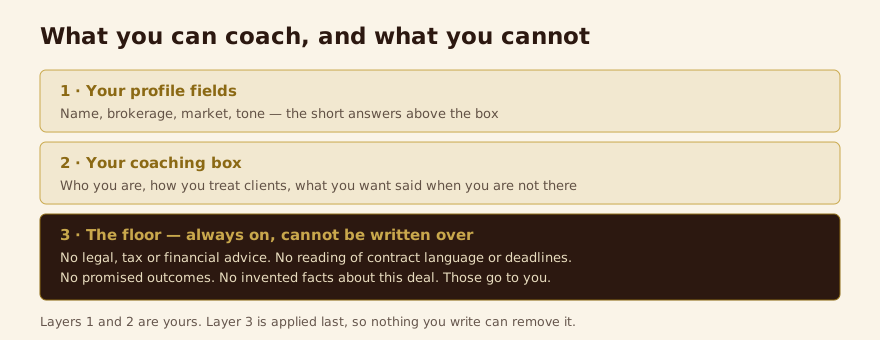
Everything you write here layers on top of the shorter fields above it, and it guides every answer your assistant gives. Two guardrails always stay on automatically, no matter what you write: it will never invent facts about a specific deal, and it will never give legal, tax, or financial advice — it hands those to you.
What a great coaching prompt covers
You do not need all five, but the best ones touch most of them.
- Who you areA sentence or two: your name, your experience, who you serve, what you are known for. This is what the assistant draws on when a client asks about you.
- How you soundWarm and folksy? Crisp and professional? Funny? Describe your tone the way a friend would describe how you talk to clients.
- What you always doYour habits and philosophy — lead with reassurance, explain before you sell, tell the truth even when it costs you, acknowledge nerves before answering.
- What you never doYour lines in the sand — never pushy, never condescending, never discuss other clients, never rush someone toward a decision.
- How to hand off to youWhen a client is ready to move forward or asks something only you should answer, how should the assistant point them back to you?
A fill-in template
Copy this into the coaching box and replace the prompts. Delete anything that does not fit.
I'm [your name]. I've [years / who you help / what you're known for].
Talk to my clients like [how you sound — e.g. a calm friend who happens to be an expert]. [Any tone notes: keep it simple, skip the jargon, be concise, be warm.]
I always [your habits — e.g. lead with reassurance, explain before I sell, tell the truth even when it costs me the deal, acknowledge when someone's nervous].
I never [your lines — e.g. push, talk down to anyone, discuss other clients, or rush a decision].
When a client is ready to move forward, or asks something only I should answer, [warmly point them to me — e.g. invite them to book a quick call rather than deciding through chat].
Two examples
Real coaching prompts read like a person, not a policy.
Warm first-time-buyer specialist
“I'm Beth, and I've helped first-time buyers across North Dallas for 12 years. Talk to my clients like a calm friend who happens to be an expert — warm, patient, and never pushy, because most of them have never done this before. Lead with reassurance, then the facts. Keep it simple; skip the jargon, or explain it in one plain sentence when you have to use it. When someone sounds nervous, acknowledge it before you answer. I tell people the truth even when it costs me the deal, and I want you to do the same. Never make anyone feel rushed. When a client seems ready to take a step, gently invite them to book a quick call with me rather than deciding anything through chat.”
Precise luxury listing agent
“I'm Marcus. I list luxury homes, and my sellers are busy, sophisticated people who value their time. Be concise, polished, and confident — every word earns its place. Speak like a seasoned professional briefing a peer, never like a salesperson. I pride myself on discretion and precision, so be exact and never overpromise. When a seller asks about pricing or strategy, give the general framework I'd use, then tell them I'll tailor the specifics with them directly. Always protect my clients' privacy, and never discuss other listings or clients.”
The “common questions” box
Right below the coaching box is a second field for the questions you hear over and over. Give the assistant your real answers and it will respond the way you actually would. The simplest format is a short list of question-and-answer pairs:
Q: How much do I need for a down payment?
A: For most of my buyers it's 3–5%, not the 20% everyone assumes. I'll introduce you to a lender who maps out your exact number for free.
Q: Should I get a home inspection?
A: Almost always yes. It's a few hundred dollars that can save you thousands and give you real negotiating leverage — and I'll be there with you for it.
Q: How long does closing usually take?
A: Typically 30–45 days from accepted offer to keys. I'll keep you ahead of every deadline so nothing sneaks up on you.
Quick do's and don'ts
Do
- Write in first person, the way you actually talk
- Be specific — “patient with nervous first-timers” beats “friendly”
- Give it your real philosophy and habits
- Tell it how and when to point clients back to you
Don't
- Put a specific client's price, dates, or terms here — those live on each storybook
- Ask it to promise outcomes or give legal or tax advice
- Write a stiff bulleted policy — it flattens your voice
- Leave it blank and expect it to sound like you
 Written by Thomas Eaves — a licensed Texas real estate agent, and the founder of Agent Storybook.