 Written by Thomas Eaves — a licensed Texas real estate agent, and the founder of Agent Storybook.
A CRM client portal is a home search tool for leads you are still converting. Agent Storybook is a client experience for the people who already hired you: it starts the day they sign and runs through closing. Most agents keep both, because they cover different halves of the same relationship.
Written by Thomas Eaves — a licensed Texas real estate agent, and the founder of Agent Storybook.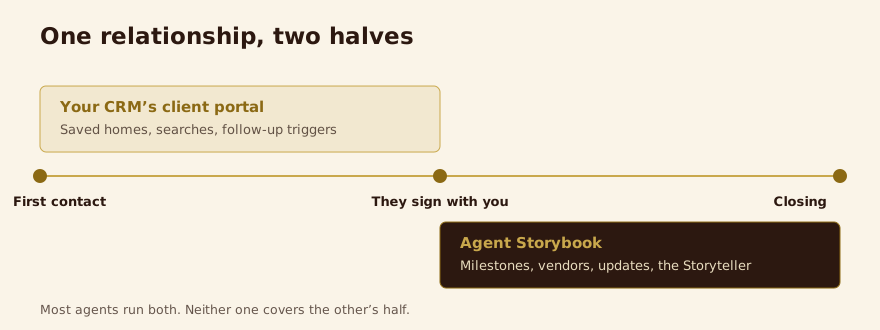
The client-facing half of a real estate CRM is a home search portal. It exists to watch what a lead saves, favorites and revisits, so it can tell you when to follow up. That is lead generation, and it is pointed at people who have not hired you yet.
Agent Storybook is pointed at the person who already did. It starts the day they sign and runs through closing — the stretch where most agents go quiet because keeping someone genuinely informed takes hours nobody has.
| Your CRM’s client portal | Agent Storybook | |
|---|---|---|
| Who it is for | Leads you are still trying to convert | The client who already hired you |
| What they see | A property search under your brand | A site of their own, for their address, with their name on the cover |
| Asking for a market update | A phone call or an email to you | One tap. It lands in your inbox with their name on it |
| Asking about the price | A phone call or an email to you | One tap — a price review for sellers, offer strategy for buyers |
| Your vendors | Not what it is built for | Inspector, lender, title, insurance — in one place, all transaction |
| A question at 11pm | Waits for you | Answered by an assistant you trained in your own voiceTeam and Brokerage plans |
| Staying in touch mid-transaction | Drip campaigns written for leads | Chapters that open on the dates you already put in the contract |
| At closing | The deal is marked closed | They are asked for a review and a referral, while they are still glowing |
No. Keep your CRM. This is not a CRM and it is not trying to become one. It does not hold your database, score your leads, run your drips or replace your pipeline. If you are choosing between the two, choose the CRM — you cannot run a business without one.
Agent Storybook picks up where the CRM stops caring: the day the contract is signed. On Team and Brokerage plans an API and a Zapier app let a new Storybook fire automatically from whatever you already run, so nobody types the same address twice.
The CRM, every time. A CRM is how you find people who have not hired you yet, and no client experience is worth anything if the pipeline behind it is empty. Agent Storybook is not an alternative to that work — it is what happens after it succeeds.
The order matters because the two are paid for out of different budgets in an agent’s head. A CRM is lead-generation spend, judged on deals sourced. A client experience is retention spend, judged on repeat business and referrals. Agents who try to justify one with the other’s numbers usually cancel both.
Agent Storybook starts at $3.99 a month and tops out at $499 for a whole brokerage, so for most agents it is a rounding error next to the CRM they already pay for. The tiers are Dual Career at $3.99 for up to 3 active Storybooks, Solo at $9.99 for 10, Team at $119 for 30 across 5 agents, and Brokerage at $499 for 500 across 250 agents.
There are no per-transaction charges and no setup fee, and every plan is month-to-month. The honest limit worth knowing before you buy: an “active” Storybook is one that is still live. Closed transactions can be archived to free the slot, so the cap is on concurrent clients, not on how many you serve in a year.
Yes, on Team and Brokerage plans, through an API and a Zapier app. A new Storybook can fire automatically the moment a deal moves to “under contract” in whatever system you already run, so nobody types the same address twice.
The limit to know: that integration is not on Dual Career or Solo. On those plans you create Storybooks from the dashboard, which takes about two minutes — the address, the client’s name, and the dates already in the contract. If automatic creation is the reason you are here, Team is the floor.
Then you already have the lead-generation half, and the gap is the months between contract and closing. Most brokerage-supplied portals are property search with the office’s branding on them; they are built to watch what a lead browses, and they go quiet the moment someone stops browsing and starts buying.
That quiet stretch is the one clients remember. It is where “I never heard from my agent” comes from, and it is not because agents stop caring — it is because keeping ten people genuinely informed takes hours nobody has.
Yes. Nothing in the product is written to one state’s rules, and your disclosure links are yours to name and upload, so a Florida or California disclosure attaches exactly the way a Texas IABS does.
The chapter content is editable on every paid plan — titles, body text, and which dates email your client — so an agent in a state with different milestones can rename and reorder them to match how transactions actually run there.
Send one to a client you already have a good relationship with and ask them what they think. That is a two-minute test that costs $3.99, and it answers the only question that matters better than any comparison table.
If you would rather not pay anything first, the free demo builds a complete Storybook with no account and no card. It is the same product; it simply is not yours to send.
Build one free. No card, no call, nothing to uninstall if you hate it.
Figures on this page come from primary industry research, not from another vendor’s blog post.